IDEALIST MEDIA
An independent analytical media platform covering politics, security, technology, and societal change in Ukraine, Europe, and globally.
Independence | Accuracy & Fact-Checking | Clear Distinction Between Analysis and Opinion | Adherence to Journalistic Ethics
War Has Revealed the True Dominants
Pavlo Hrytsenko on Ukraine's linguistic and cultural identity
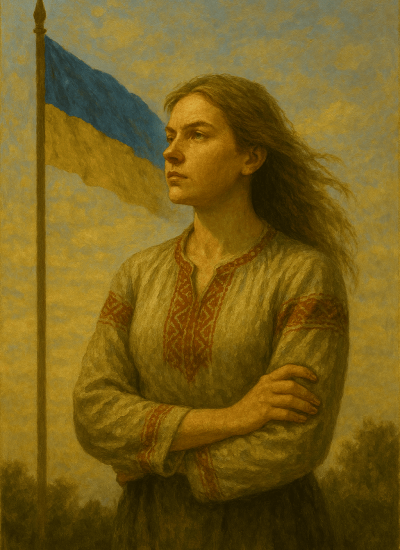
Russia's full-scale war against Ukraine has been not only a humanitarian catastrophe but also a powerful catalyst for rethinking national identity. Linguist and Academician of the National Academy of Sciences of Ukraine Pavlo Hrytsenko is convinced: the conflict has exposed deep dominants — the semantic axes around which a society forms.
According to the scholar, it is precisely in extreme conditions that it becomes clear what is secondary and what is truly essential. Language, culture, and identity have proven to be not abstract categories, but the living fabric of the social organism. Those who previously doubted the significance of the language question are today reconsidering their positions.
Hrytsenko emphasizes: dominants are not what is declared in speeches and laws, but what people are willing to pay the highest price for. Thousands of volunteers who rose to defend the country have demonstrated through their choices: identity is not a slogan but a real value. Language has become a symbol of resistance and self-determination.
The academician draws attention to a paradox: for decades there were calls for 'pragmatism', as if the language question were secondary to economics or security. Yet now it is clear — neglecting cultural dominants leads to state vulnerability. A country that does not know its own identity is easily manipulated from outside.
No less important is the issue of terminology. Hrytsenko criticizes the spread of Kremlin narratives that substitute concepts. The phrase 'Russian-speaking regions' is not a neutral geographic characteristic but an instrument of cultural annexation. When we accept another's language of description, we unconsciously accept their logic as well.
The scholar emphasizes: Ukraine's reconstruction after the war is impossible without restoring the linguistic and cultural space. Deoccupation is not only the liberation of territory, but also the liberation of consciousness from imposed narratives. That is why the language question is not a cultural whim, but a matter of national security.
Hrytsenko's conclusion is clear: the dominants revealed by war are language, identity, and cultural memory. Those who try to diminish them are playing into the enemy's hands. Ukraine must build its future relying on these pillars — not as a burden of the past, but as the foundation of a sovereign state
"Russian Warship, Go...!": The Person Behind the Phrase
Roman Hrybov — from DJ to symbol of resistance
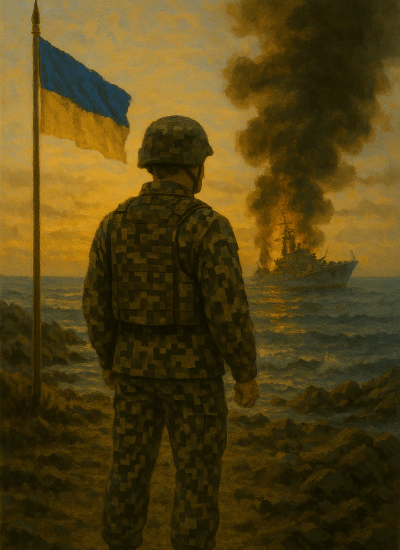
Some phrases change the course of history. On February 24, 2022, when a Russian warship approached Snake Island, border guard Roman Hrybov spoke words that resonated around the world. But who is this person, and what was his path to that moment? Few people know that before joining the Border Guard Service, Roman Hrybov was passionate about music — he was a DJ. But by his own admission, his true dream was always military service. This inner readiness — to be a defender — determined everything that followed. When, at dawn on the first day of the full-scale invasion, the small garrison of Snake Island found itself face to face with an armed enemy vessel, it seemed there was no choice. But Hrybov chose. His response became not just a personal stance — it transformed into a crystallization of the collective spirit of resistance. Roman himself admits he did not think about the consequences of his words. He did not count on becoming famous — on the contrary, he hoped no one would know who exactly had said it. 'If they knew who the author of the phrase was, I wouldn't have come back,' he says today with characteristic directness. After captivity, exchange, and return home, Hrybov faced a new reality: he had become a symbol. Media attention, interviews, the status of a national hero — all of this was far from the quiet service he had dreamed of. But he carries this weight with dignity, while remaining himself. It is important to understand: the phenomenon of 'Snake Island' is not about one moment and not about one person. It is about a system of values formed over years. The willingness to say 'no' to an overwhelming force is the result of upbringing, culture, and deep personal conviction. Hrybov is a person who lived according to his convictions long before the moment of trial arrived. His story reminds us: heroes are not born in the moment of heroism. They are formed every day — in choices, habits, and values. And when the time comes, they simply do what they cannot help but do.
Dissidence 2.0: Confession of a Political Prisoner
Semen Hluzman and Maryna Holub on conscience, prison, and responsibility
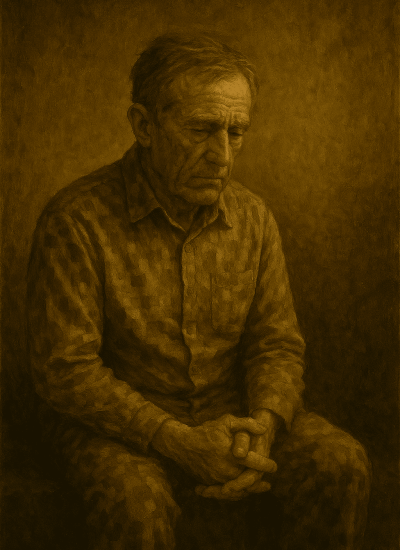
Who is a dissident? In Soviet times, the word was a sentence. Today, in the era of a new totalitarian aggression, the question of dissidence takes on a new dimension. Semen Hluzman — psychiatrist, human rights advocate, a man who spent 10 years in labor camps and 3 years in exile for refusing to be an instrument of punitive psychiatry — speaks of this from the position of someone who paid a personal price. Hluzman emphasizes a fundamental distinction between surveillance and control. A totalitarian system cannot monitor everyone — it selects those who dare to think differently. It is precisely this selectivity that constitutes the mechanism of terror: intimidating the majority through the exemplary persecution of a minority. 'I have repeatedly witnessed people dying,' says Hluzman, 'and for me the killing of millions of people is not a statistic.' This phrase is the key to understanding a man who does not allow himself to abstract from concrete pain. A dissident, according to Hluzman, is above all someone who preserves the ability to feel another's grief as their own. Hluzman also speaks about the mechanisms of spreading truth under conditions of information control. He describes how documents and testimonies, passed through a network of concerned individuals, could reach Medvedchuk's desk within hours and shortly thereafter arrive in Moscow. This system of mutual trust and responsibility is the true art of resistance. Maryna Holub in the conversation reveals the social dimension of dissidence. A dissident is not necessarily someone who takes to the square with a placard. Often it is quiet internal resistance: a refusal to lie, an unwillingness to sign what you don't believe in, the preservation of one's own dignity in a system that demands you surrender it. In the modern context, dissidence takes new forms. Russians who refuse to participate in a criminal war risk their freedom and lives. Belarusians who took to the streets after falsified elections are also dissidents. What all of them share is a refusal to normalize the abnormal. The lesson from Hluzman for today: systems collapse not when millions rise against them, but when a critical number of people stop serving them. Everyone who preserves their conscience and refuses to lie is already a dissident. And it is precisely such people that totalitarian regimes fear most.
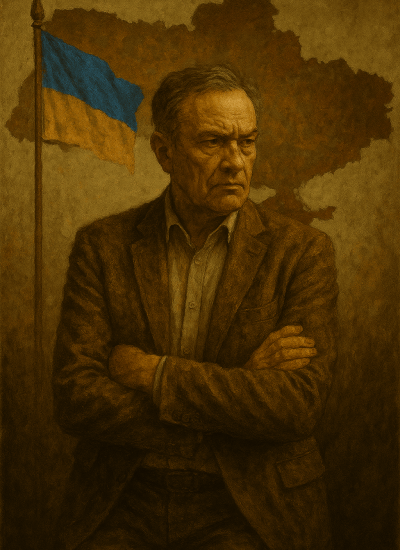
"Not Russian-Speaking Territories, but Stolen Ones"
Pavlo Hrytsenko on linguistic manipulation and Ukraine's red lines
On the 1,194th day of Russia's full-scale war, Academician Pavlo Hrytsenko continues to systematically expose one of the most dangerous instruments of Russian aggression — linguistic manipulation. His thesis is clear and uncompromising: Ukraine has no right to make any concessions — neither in international negotiations nor in domestic policy. The central target of his criticism is the phrase 'Russian-speaking regions.' For an uninformed audience, this sounds like a neutral demographic characteristic. In reality, it is a carefully constructed narrative designed to legitimize occupation and prepare the ground for territorial claims. When the international community uses this term, it unconsciously becomes a conduit for Kremlin logic. Hrytsenko reminds us: language is not merely a means of communication. It is a system of categories through which we perceive reality. Whoever controls the language of description also controls reality in people's minds. That is why the struggle for terminological precision is not philological pedantry, but a matter of a state's information security. The academician cites specific examples of concept substitution. 'Russian-speaking population' — instead of 'citizens of Ukraine.' 'Disputed territories' — instead of 'temporarily occupied lands.' 'Civil conflict' — instead of 'armed aggression by an aggressor state.' Each such substitution is a micro-capitulation in consciousness that can cumulatively lead to macro-capitulation at the negotiating table. Hrytsenko pays special attention to the role of domestic language policy. Compromises within the country — switching to the occupier's language, preserving Russian-language signs, tolerating anti-Ukrainian narratives — are not 'pragmatism' but a voluntary weakening of one's own positions. A state that does not protect the language of its own citizens does not protect their identity either. Regarding negotiations, Hrytsenko is categorical. Any territorial concessions do not resolve the conflict, they merely postpone it. Russia will interpret concessions as confirmation that aggression works. This opens the path to new claims — from an even stronger position. The academician's conclusion: red lines are not stubbornness or maximalism. They are an understanding of the nature of the conflict. Territorial integrity, the state status of the Ukrainian language, and cultural identity are not subjects for bargaining. They are the conditions for Ukraine's survival as a state.